
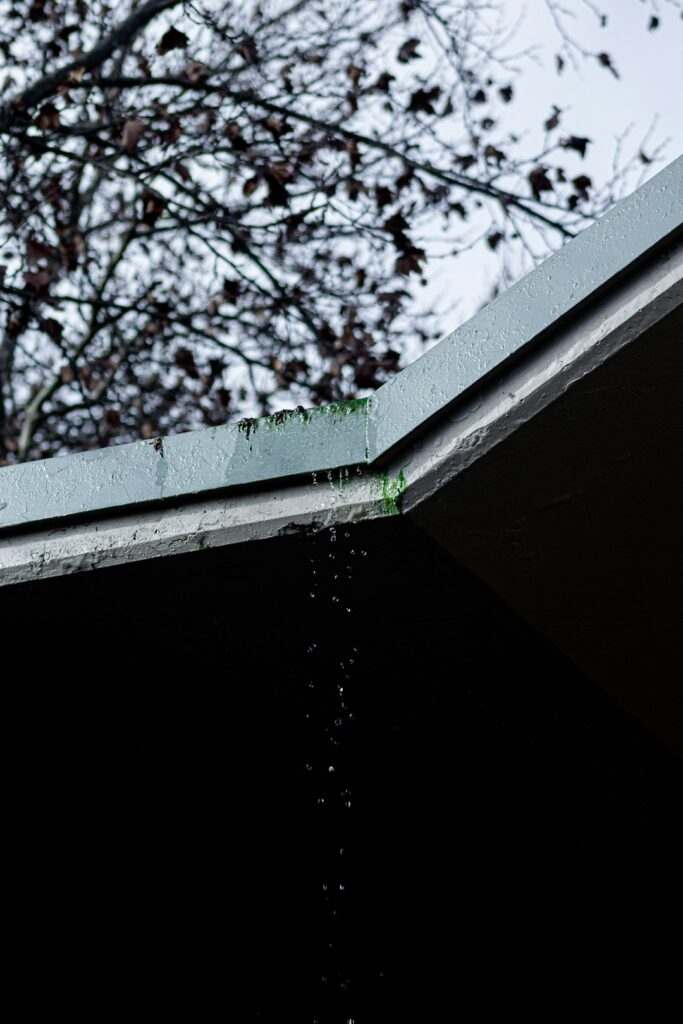
How do gutters protect a roof?
Gutters protect a roof by collecting rainwater and directing it away from the roof edge, siding, foundation, and surrounding soil. Although gutters are attached near the lower edge of a roof, their condition can affect several parts of the roofing system.
Without a clear drainage path, water may remain along the eaves, spill over the sides, or run behind the gutter. Repeated exposure can contribute to:
- Rot in roof-edge wood and fascia boards
- Deterioration of soffits and exterior trim
- Water staining or dampness along upper walls
- Erosion near the foundation
- Basement moisture and drainage problems
- Ice buildup during freezing weather
A gutter does not make a roof watertight by itself. Instead, it supports the roof’s flashing, underlayment, shingles, and edge details by moving water away before it can collect in vulnerable areas.
Why is gutter maintenance especially relevant in Cooperstown?
Cooperstown experiences wet weather throughout the year, along with cold winters, repeated freezing and thawing, and regular snow. These conditions place extra stress on roof drainage systems.
Leaves, small branches, seed pods, and roof granules can collect in gutters during the growing season. In winter, trapped debris can restrict meltwater just as temperatures fluctuate around freezing. Water that cannot drain may freeze inside the gutter or along the roof edge, adding weight and increasing the chance of overflow.
Older homes and buildings with mature trees may need more frequent observation because their roof valleys and gutters can receive a heavy volume of organic debris. Steep slopes, dormers, additions, and roof sections that meet at different levels can also concentrate runoff in specific areas.
What happens when gutters overflow?
Overflowing gutters do not always mean the gutters themselves are the only problem. The cause may be leaves, ice, sagging sections, an undersized downspout, poor pitch, or water arriving too quickly from a large roof area.
When water spills over the front edge, it can soak fascia boards and splash against siding. When water runs behind the gutter, it may wet the roof-edge wood that is meant to remain protected. Over time, this can lead to soft wood, peeling paint, staining, or hidden decay.
Overflow near a doorway, walkway, or driveway can also create slippery surfaces in freezing weather. Water discharged too close to the foundation may contribute to damp crawl spaces, basement walls, or settlement of soil near the building.
Can clogged gutters cause roof leaks?
Clogged gutters can contribute to roof leaks, but they are not the cause of every leak. A blockage becomes more concerning when water backs up beneath the roof’s edge or remains against deteriorated wood and flashing.
Roof leaks may also result from damaged shingles, failed pipe flashing, open seams, improper roof penetrations, or ice dams. A ceiling stain located near an outside wall may be related to roof drainage, but the visible stain does not always identify the exact entry point. Water can travel along roof decking, framing, or insulation before appearing indoors.
For that reason, gutter cleaning alone may not resolve a leak if roofing materials or flashing are already damaged.
Do gutters cause ice dams?
Gutters do not usually create ice dams by themselves. Ice dams form when snow on a warmer portion of a roof melts and the water refreezes near a colder eave. A blocked or ice-filled gutter can make the drainage problem worse by preventing meltwater from leaving the roof edge.
Ice dams are more likely when several conditions occur together:
- Heat escapes into the attic and warms the roof deck
- Snow covers the roof during below-freezing weather
- The eaves remain colder than the upper roof
- Meltwater cannot drain freely
- Existing ice grows along the roof edge
The resulting ice can hold water against shingles and underlayment. That water may eventually work into the roof assembly and cause interior damage.
Reducing ice dams requires more than removing gutter debris. Attic air sealing, insulation, roof ventilation, proper underlayment, and safe snow-management practices may all be relevant. Large ice formations should not be chopped with sharp tools, and roof work during icy conditions can be hazardous.
How often should gutters be checked?

There is no single schedule that fits every home, but gutters should be checked at least during the main leaf season and before winter weather becomes established. Properties surrounded by mature trees may need additional checks after heavy storms or periods of rapid leaf drop.
A basic inspection should look for:
- Standing water or packed debris
- Sagging or separated gutter sections
- Loose fasteners
- Cracks, holes, or rusted areas
- Downspouts that discharge against the foundation
- Water stains behind the gutter
- Peeling paint or soft wood along the fascia
- Ice buildup that pulls the gutter away from the roof edge
Water can be poured carefully into a gutter section to confirm that it flows toward the downspout. This should only be done from a safe position on the ground or from a properly secured access point. Climbing onto a roof during wet, icy, or snowy conditions creates a significant fall risk.
Where should downspouts discharge water?
Downspouts should direct water far enough away from the building to prevent it from collecting beside the foundation. The exact arrangement depends on the slope of the property, soil conditions, landscaping, walkways, and whether the building has a basement or crawl space.
A downspout that empties directly beside the foundation can defeat the purpose of the gutter system. Extensions or below-grade drainage may be useful in some situations, but they must be arranged so water does not flow toward a neighboring structure, public walkway, septic area, or unstable slope.
Rain barrels and other collection systems also require winter planning. In a cold climate, stored water can freeze and damage containers or connected fittings if the system is not designed for winter conditions.
Do all roofs need gutters?
Not every roof requires the same gutter arrangement. Some small structures, steeply sloped roofs, or buildings with wide roof overhangs may shed water away from walls without conventional gutters. However, removing or omitting gutters can create problems if runoff lands near the foundation, erodes soil, or repeatedly wets exterior walls.
The decision depends on roof size, slope, overhang, building design, site drainage, and the materials used at the roof edge. A gutter system should work with the roof rather than simply being attached to it as an afterthought.
What signs suggest a roof and gutter problem?
Warning signs include recurring leaks near exterior walls, water marks on soffits, overflowing gutters during ordinary rain, stains below roof valleys, damp basement areas, and gutters that pull away from the fascia. Shingle granules collecting in the gutter may be normal on a newer roof, but a sudden increase can indicate roof-surface wear.
A roof drainage issue should be treated as a system problem. Checking only the shingles or only the gutters may miss damaged flashing, deteriorated edge wood, poor attic ventilation, or an improperly directed downspout.
Routine observation, safe debris removal, and prompt attention to overflow or water entry can help preserve the roof assembly and reduce the chance that a manageable drainage issue develops into concealed structural damage.
